Table of Contents
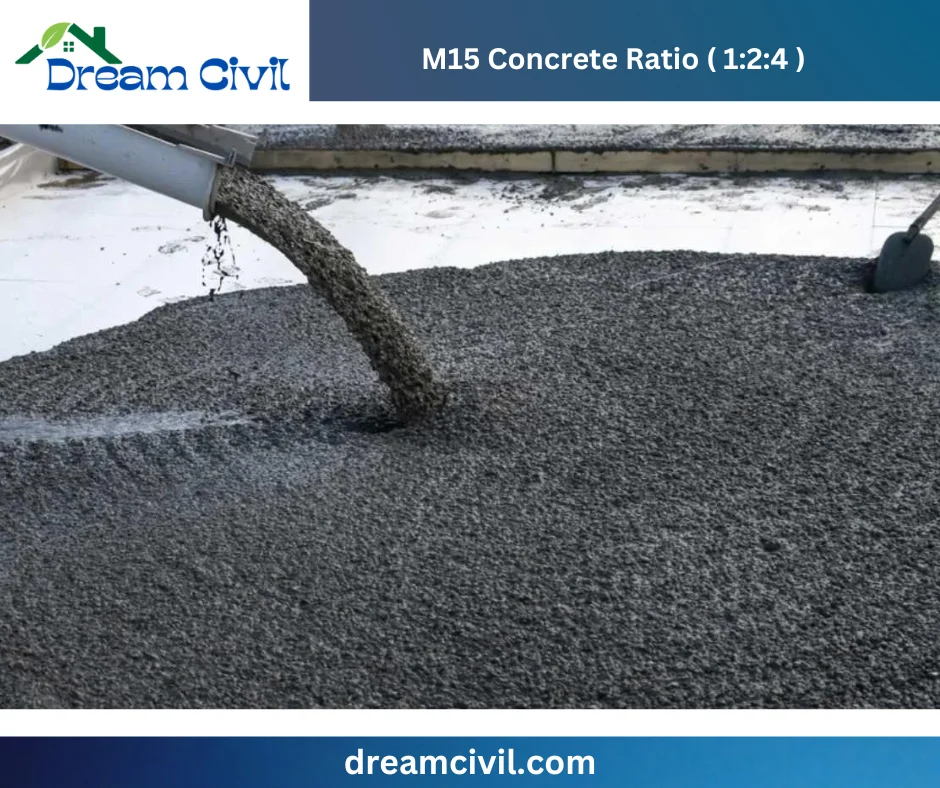
M15 Concrete at First Glance Nominal Mix = 1:2:4 represents volumetric proportions= 1 part cement: 2 parts sand: 4 parts aggregate Characteristic strength = 15 MPa at 28 days Common Uses = Used for non-structural and general-purpose work Maximum water-cement ratio = 32 liter per 50 kg cement IS Code = IS 456:2000 |
You may ask: Is the M15 concrete ratio still used in construction today? My answer is yes; it’s still used today, but mainly for temporary and less important structures.
Being a civil engineer, I am currently working at several sites as a supervisor. From my experience, we use M15 concrete ratio for budget control and cost reduction.
For example, we use M15 concrete ratio for less important structures that do not take much load and do not impact the strength of the structure. This saves the budget by reducing the quantity of cement required.
1. Skip manual calculations and use our interactive M15 material calculator
I have developed this calculator to ease you to calculate the quantity of materials based on the grade of concrete.
2. M15 Concrete Ratio – Overview
The concrete having a characteristic compressive strength of 15 MPa after 28 days of curing is known as M15 concrete.
M15 concrete ratio is 1:2:4 . It indicates the cement:sand: aggregate ratio. It simply means that if 1 part of cement is used for making Concrete, you should use 2 parts of sand and 4 parts of aggregate.1
✔ In M15 concrete,
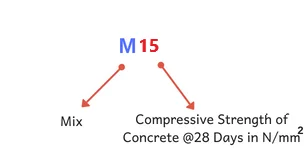
- “M” denotes Mix ratio of cement : sand : aggregate & “ 15 ” stands for Compressive Strength @ 28 Days in N/mm².
Table Based On: IS 456:2000 ( Clause 9.3 & 9.3.1, Table 9 )
| Code | IS 456 : 2000 ( 2005 Reaffirmed ): Plain and Reinforced Concrete – Code of Practice |
| Grade Category | Normal Grade ( Nominal Mix ) |
| Ratio | 1:2:4 |
| Compressive Strength | 15 MPa { Note: MPa = N/mm²} |
| Total Dry Aggregate per 50 kg Cement | 330 kg ( with fine-to-coarse aggregate ratio in 1:2 proportion ) |
| Max Water per 50 kg Cement Bag | 32 Litres per 50 kg bag ( 0.55 is typically specified on-site for better quality ) |
3. M15 Concrete Ratio Uses
Some common uses of the M15 Concrete Ratio are:
✔ Used in the construction of boundary wall pillars.
✔ Used in general-purpose work or temporary structures.
✔ Used in the construction of parking, landscaping, gardening, etc.
Do not use this concrete for structures that need to carry a heavy load because I have seen the development of cracks, seepage problems and many other problems there.
4. How can we prepare M15 Concrete?
We can prepare M15 concrete at site in the following steps:
a. Materials Selection
Choosing either PPC or OPC cement, sand based on origin and aggregate based on size is the first step.
We commonly use OPC at site because it starts to set faster compared to PPC. Using too big aggregates may result in the development of cracks in concrete due to improper bonding.
b. Batching
Nominal mixes are given by volume. So, the M15 ratio represents 1 part cement : 2 parts sand : 4 parts aggregate by volume.
c. Mixing of Materials
We can perform hand mixing or machine mixing based on suitability. Hand mixing may result in improper mixing, so my first choice is machine mixing.

d. Transportation & Placing
Transporting concrete should be done using an iron pan or wheel barrow or concrete pump. Then concrete is placed in the desired place.

e. Compaction of Concrete
Freshly placed concrete should be compacted with vibrators. The main aim of compaction is to remove air bubbles or air voids.
f. Finishing of Surface
After concreting, the rough concrete surface is levelled and smoothed during the finishing process.
g. Curing of concrete
Curing is done to support the hydration reaction of concrete that results in high strength of concrete.
5. Cement, Sand & Aggregate Calculation for 1 m³ M15 Concrete Ratio ( Numerical )
| Things To Know!!
Density of Cement = 1440 kg/m3 Density of Sand = 1450-1500 Kg/m3 Density of Aggregate = 1450-1550 Kg/m3 Weight of Cement in 1 Bag = 50 Kg Volume of 1 Bag of Cement in Cubic meter = 0.03472 m3 |
Now, Taking
Grade of Concrete = M15 Concrete
Mix Ratio = 1:2:4
Total sum of ratio =1+2+4 =7
Wet volume of Concrete = 1 m3
To get the dry volume, the wet volume is increased by 54%
Dry volume of concrete = 1+ 1 * 0.54 = 1.54 m³ (54% is taken for losses and volume change due to compaction, batching method,etc.)
i. Cement Quantity Calculation
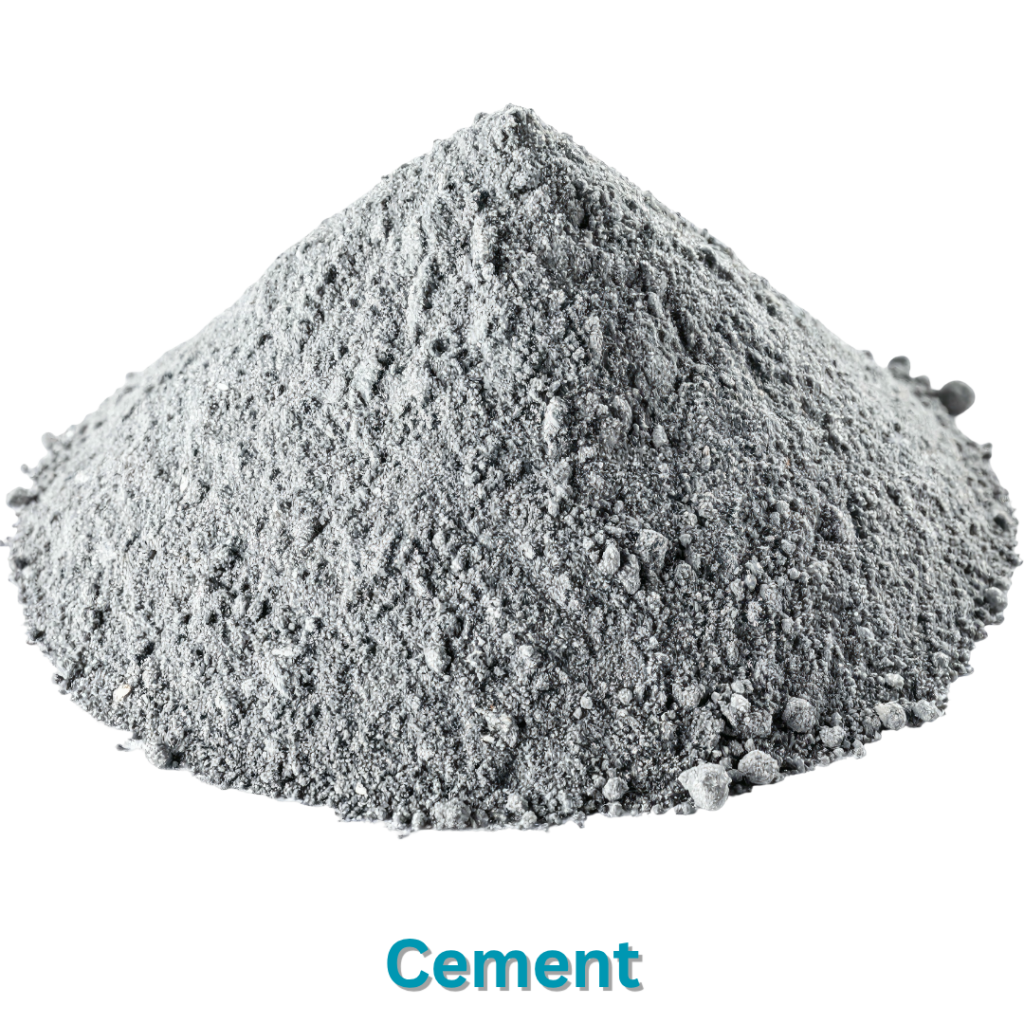
Quantity of cement = (Own Ratio/ Total sum of ratio) * Dry Volume
= ( 1/7 ) * 1.54
= 0.22 m³
Cement in kg = volume of cement * density of cement
= 0.22 * 1440
= 316.8 kg
ii. Sand Quantity Calculation
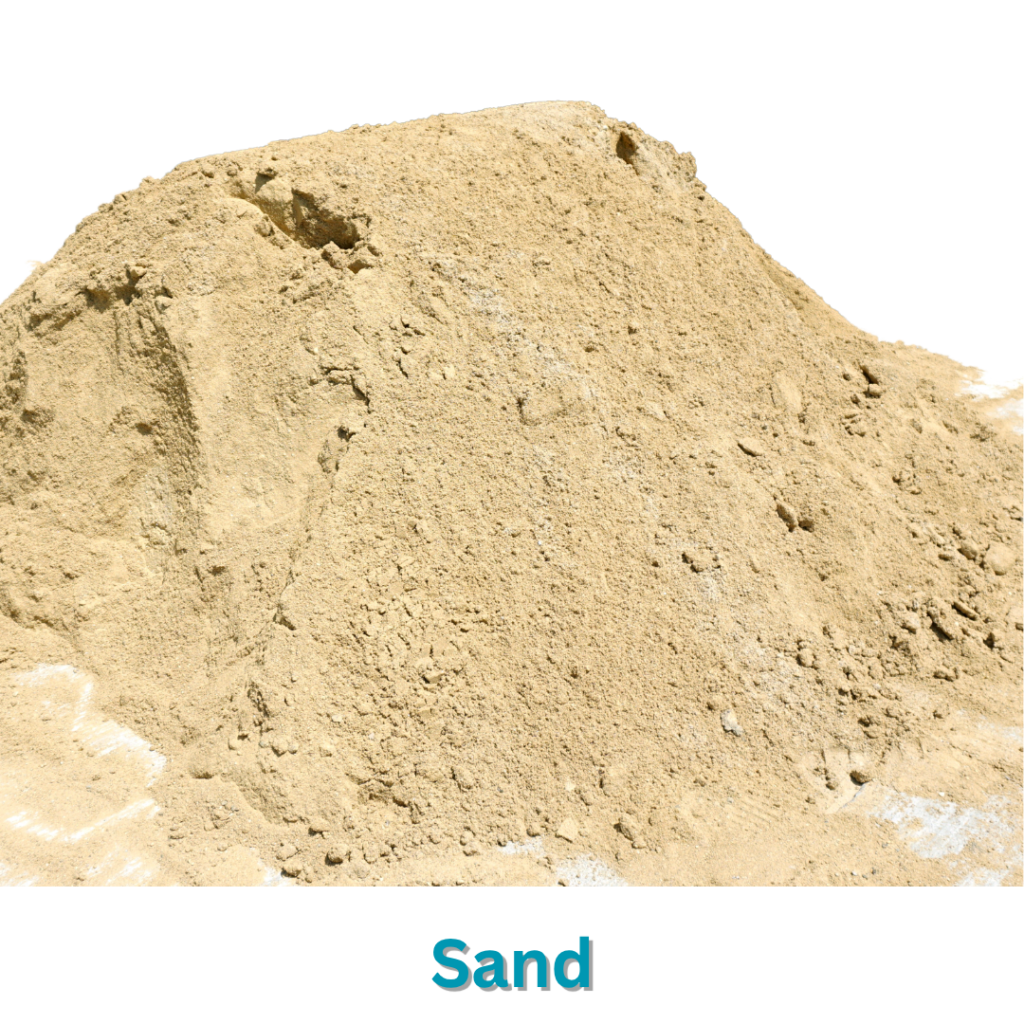
Quantity of sand = (Own Ratio/ Total sum of ratio) * Dry Volume
= ( 2/7 ) * 1.54
= 0.44 m³
iii. Aggregate Quantity Calculation

Quantity of aggregate = (Own Ratio/ Total sum of ratio) * Dry Volume
= ( 4/7 ) * 1.54
= 0.88 m³
iv. Water Calculation
Amount of water required per m³ = 0.55 * 316.8 = 174.24 kg
( IS 456:2000 Table 9 allows up to 32 litres of water per 50 kg bag of cement (W/C ratio of 0.64), but I have taken 0.55 to prevent segregation and ensure proper workability.)
| Concrete (m³) | Cement (kg) | Cement (Bags) | Sand (m³) | Aggregate (m³) | Water @ W/C 0.55 (L) |
|---|---|---|---|---|---|
| 1 | 316.8 | 6.34 | 0.44 | 0.88 | 174.24 |
| 2 | 633.6 | 12.67 | 0.88 | 1.76 | 348.48 |
| 3 | 950.4 | 19.01 | 1.32 | 2.64 | 522.72 |
| 4 | 1267.2 | 25.34 | 1.76 | 3.52 | 696.96 |
| 5 | 1584.0 | 31.68 | 2.20 | 4.40 | 871.20 |
| 6 | 1900.8 | 38.02 | 2.64 | 5.28 | 1045.44 |
| 7 | 2217.6 | 44.35 | 3.08 | 6.16 | 1219.68 |
| 8 | 2534.4 | 50.69 | 3.52 | 7.04 | 1393.92 |
| 9 | 2851.2 | 57.02 | 3.96 | 7.92 | 1568.16 |
| 10 | 3168.0 | 63.36 | 4.40 | 8.80 | 1742.40 |
| 11 | 3484.8 | 69.70 | 4.84 | 9.68 | 1916.64 |
| 12 | 3801.6 | 76.03 | 5.28 | 10.56 | 2090.88 |
| 13 | 4118.4 | 82.37 | 5.72 | 11.44 | 2265.12 |
| 14 | 4435.2 | 88.70 | 6.16 | 12.32 | 2439.36 |
| 15 | 4752.0 | 95.04 | 6.60 | 13.20 | 2613.60 |
| 16 | 5068.8 | 101.38 | 7.04 | 14.08 | 2787.84 |
| 17 | 5385.6 | 107.71 | 7.48 | 14.96 | 2962.08 |
| 18 | 5702.4 | 114.05 | 7.92 | 15.84 | 3136.32 |
| 19 | 6019.2 | 120.38 | 8.36 | 16.72 | 3310.56 |
| 20 | 6336.0 | 126.72 | 8.80 | 17.60 | 3484.80 |
6. How strong is M15 Concrete compared to other grades?
Based on the strength of concrete, I have prepared this table comparing it with other concrete grades.
| Concrete Grade | 28-Day Strength (MPa) | Compared to M15 | Application |
|---|---|---|---|
| M10 | 10 | 33% Weaker | PCC |
| M15 | 15 | Base Grade | PCC / General Works |
| M20 | 20 | 33% Stronger | RCC where specified |
| M25 | 25 | 67% Stronger | Structural Applications |
7. How is Nominal Mix different from Design Mix?
| Nominal Mix | Design Mix |
| It is less accurate and unoptimized compared to design mix. | It is more accurate and economical compared to nominal mix. |
It is described by IS 456:2000 (Clause 9.3 & Table 9). | It is described by IS 10262:2019. |
| It is used for general-purpose works. | It is used where high strength is required, like dams, bridges, big buildings and more. |
| M20 and below grades fall under Nominal Mix. | M25 and above grades fall under Design Mix. |
| It uses prescribed proportions. | It is designed to achieve specified strength. |
8. FAQs About M15 Concrete
a. Which standard is followed by the M15 Concrete Ratio?
Ans: M15 Concrete Ratio follows IS 456:2000 ( 2005 Reaffirmed ): Plain and Reinforced Concrete – Code of Practice.
b. What is the commonly used water-cement ratio for M15 concrete?
Ans: For M15 Concrete, the commonly used water-cement ratio is 0.55.
c. What is M15 concrete?
Ans: It is a concrete having a compressive strength of 15 MPa (15 N/mm²) after 28 days of curing and prepared by using 1 part cement, 2 parts sand and 4 parts aggregate.
d. What is the mix ratio of M15 concrete?
Ans: The mix ratio of M15 Concrete is 1:2:4.
e. What is the strength of M15 concrete?
Ans: M15 concrete has a compressive strength of 15 MPa (15 N/mm²).
f. Where is M15 concrete used?
Ans: It is used in the construction of parking, garden pathways, boundary wall pillars, landscaping and similar less important structures that do not take much load.
g. Is M15 concrete suitable for RCC?
Ans: No, M15 concrete is not suitable for RCC work. The minimum grade to be used for RCC work is M20 as per IS 456.
h. How many cement bags are required for 1 m³ of M15 concrete?
Ans: 6.34 bags ( 316.8 kg ) of cement (50 kg each) are required to produce 1 cubic meter of M15 concrete.
i. What is the density of M15 concrete?
Ans: The density of M15 concrete is around 2400 kg/m³.
j. Can M15 concrete be used for house construction?
Ans: No, it cannot be used for structural elements (like beams, slabs, columns, etc) but can be used for non-structural elements and bedding work.
k. How long does M15 concrete take to gain full strength?
Ans: Along with M15 concrete, all concrete grades need around 28 days to gain full strength.
l. Which is better, M20 or M15?
Ans: M20 concrete is better than M15 concrete because M20 concrete provides 33% more strength thanM15 concrete.
| Written By | Madhu Krishna Poudel |
| Role | Construction Site Supervisor | Founder, DreamCivil |
| Experience | 8+ years of practical construction experience |
| Technically reviewed by | Er. Bikas Kafle |
- Bureau of Indian Standards, IS 456:2000 — Plain and Reinforced Concrete — Code of Practice
https://law.resource.org/pub/in/bis/S03/is.456.2000.pdf [↩]