Table of Contents
Concrete is ordered in cubic metres or cubic yards, steel by weight, bricks by count. Timber in North America has its own unit, the board foot, and anyone who estimates, orders or checks a lumber delivery needs to be comfortable with it. The good news is that the board foot is simply a volume, and once you see how it is built, the calculation takes seconds.
What a board foot is?
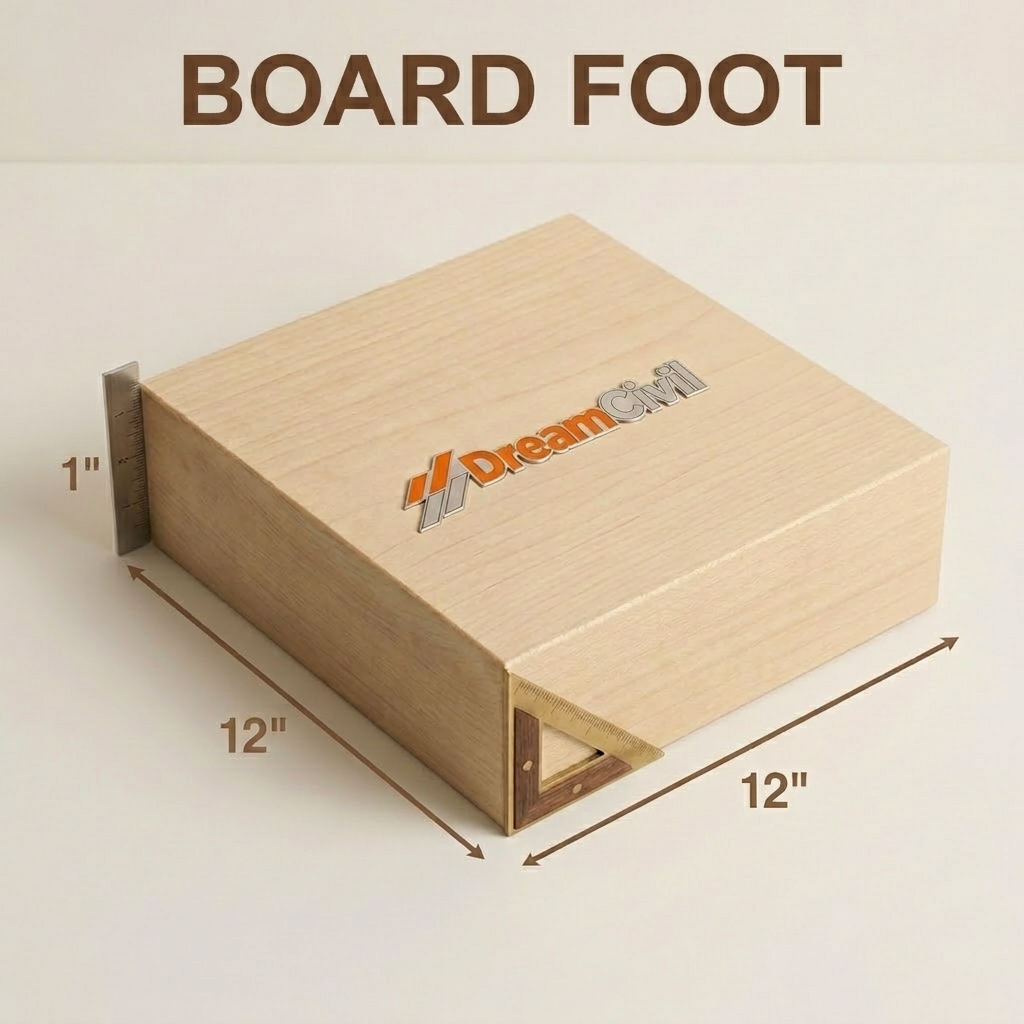
One board foot is the volume of a piece of wood 1 inch thick, 12 inches wide and 12 inches long — 144 cubic inches. It is a unit of volume, not length, which is why a long thin board and a short thick one can contain exactly the same number of board feet.
In metric terms:
- 1 board foot = 144 in³ ≈ 2.36 litres ≈ 0.00236 m³
- 1 m³ ≈ 424 board feet
- 1,000 board feet (often written MBF) ≈ 2.36 m³
The formula
For a single piece with thickness and width in inches and length in feet:
Board feet = thickness (in) × width (in) × length (ft) ÷ 12
If all three dimensions are in inches, divide by 144 instead. For several identical pieces, multiply by the quantity.
Worked examples
- One 2×4, 8 ft long: 2 × 4 × 8 ÷ 12 = 5.33 board feet
- One 2×10, 16 ft long: 2 × 10 × 16 ÷ 12 = 26.67 board feet
- Twenty 1×6 boards, 10 ft long: 1 × 6 × 10 ÷ 12 × 20 = 100 board feet
- One 6×6 post, 12 ft long: 6 × 6 × 12 ÷ 12 = 36 board feet
Nominal versus actual size
A finished “2×4” actually measures about 1½ × 3½ inches, because the board is dried and planed after sawing. Softwood dimensional lumber is normally sold and tallied on its nominal size, so you calculate with 2 × 4, not 1½ × 3½. Hardwood is different: it is sold rough, in quarter-inch thickness grades — 4/4 is one inch, 8/4 is two inches, 6/4 is one and a half — and the board foot is counted on that rough thickness. Mixing the two conventions is the most common source of disagreement between a quantity estimate and a supplier’s invoice.
Using board feet in an estimate
A practical sequence for a framing or formwork take-off:
- List every member by section and length, grouped by size.
- Calculate board feet per group and add them up.
- Add a wastage allowance — typically 10–15% for framing, more for formwork with many cuts.
- Multiply by the supplier’s price per board foot (or per MBF) to get the material cost.
Because sizes repeat, a table of common sections saves time. A free board foot calculator does the same job instantly: it accepts fractions such as 1 1/2 and hardwood grades like 8/4, multiplies by quantity and price, and switches to millimetres and cubic metres when a project is specified in metric.
Common mistakes
- Forgetting the ÷12. Multiplying inches by feet without dividing gives an answer twelve times too large.
- Mixing units. Width in millimetres and length in feet will never produce a meaningful result; convert first.
- Ignoring quantity. The formula gives one piece; a bundle needs the count.
- Using actual size for softwood. It under-reports the volume you are being charged for.
Conclusion
The board foot looks old-fashioned next to the cubic metre, but it is just a convenient slice of volume — one inch by one foot by one foot. Learn the single formula, keep nominal and rough sizes straight, and lumber quantities become as routine as any concrete or steel calculation on site.