Table of Contents
It is well-established that lubricant plays a crucial role in ensuring the reliability of all manner of industrial machinery. Products like silicone lubricant and other types of oil, grease, and specialist lubricants are formulated to help maintain equipment and component performance across a broad range of temperatures.
However, there is equally no denying that temperature is one of the most influential factors governing how well a lubricant does its job. Temperatures escalating or plummeting can have implications for viscosity, film strength, oxidation rate, and additive longevity.
Engineers and maintenance personnel need to have a good understanding of these various effects if they are to choose the best lubricant for a particular application, in addition to setting appropriate change intervals and avoiding premature wear or downtime.
This article, then, will set out the essentials of what temperature rises and falls can mean for the lubricant used in industrial machinery.
Where Lubricants Are Needed, Temperature Can’t Be Ignored ?
Lubricants are designed with the purpose of reducing friction between moving surfaces. This, in turn, helps minimise wear and heat generation. Such products can also provide protection against corrosion, while helping machinery operate more smoothly.
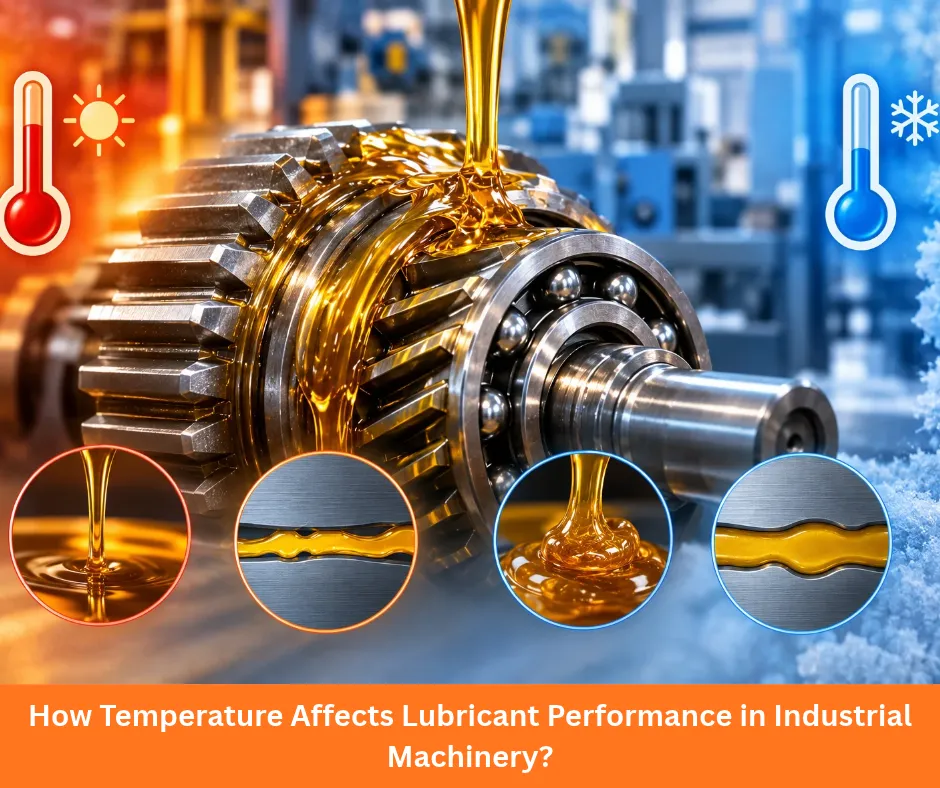
However, lubricants don’t behave the same way at every temperature. Viscosity, for instance, which is essentially the readiness with which a fluid flows, is highly temperature-dependent.
- As temperature goes up, most oils and greases become thinner. This raises the prospect of the protective film between moving surfaces potentially thinning to the point where metal-to-metal contact increases. In the event of this, abrasive and adhesive wear will likely be higher.
- Conversely, at low temperatures, lubricant typically thickens. This heightens internal friction, makes pumping and circulation more difficult, and can leave bearings or gears starved of oil during cold starts.
What Else Do Engineers Need to Know About Lubricant Use at High Temperatures?
As well as lower viscosity, high temperatures can have the effect of speeding up lubricant ageing and oxidation. Depending on the formulation and operating conditions, this may contribute to deposits, degradation, or the lubricant simply becoming less effective over time.
As a general rule of thumb, the rate of many chemical reactions, including oxidation, increases substantially as temperature rises. A commonly used approximation is that reaction rates can double for every 10 °C increase. However, the actual effect varies according to the lubricant formulation and operating conditions.
All this is why high-temperature applications typically call for the use of lubricants specifically formulated to maintain suitable performance at elevated temperatures.
What About the Effects That Low Temperatures Have on Lubricants?
As touched on above, a drop in temperatures is generally associated with lubricating oils becoming more viscous. If a lubricant becomes excessively thick, it may not reach moving components quickly enough. As a result, friction in affected machinery could be higher, and component wear might worsen.
Unsurprisingly, the issue of cold temperatures can be particularly important for equipment operating outdoors, as well as in unheated facilities or in refrigerated environments.
Pour point is one useful indicator of an oil’s low-temperature behaviour. However, engineers should also consider viscosity at the expected operating and start-up temperatures, as well as the lubricant manufacturer’s specified operating range.
Conclusion: Temperature Is a Vital Factor When a Lubricant Must Be Chosen
Choosing the most suitable lubricant for a given task and the associated operating conditions, while also putting appropriate temperature-control measures in place, can help reduce the total cost of ownership of industrial machinery.
When a lubricant’s capabilities are well-matched to the thermal demands of a particular application, industrial plants will be strongly placed to keep their equipment running smoothly, through seasonal change and process heat alike.